Fábricas verificadas una a unaPrecio final con transporte, aduana e impuestosServicio técnico y garantía incluidos

Commercial & industrial refrigeration

Refrigeration is the one piece of equipment that can't fail. When an oven stops you change the day's menu; when a cold room stops you lose stock and close. That's why buying refrigeration works differently: not on list price, but on whether the unit will hold up under your real workload, in your premises, in August.

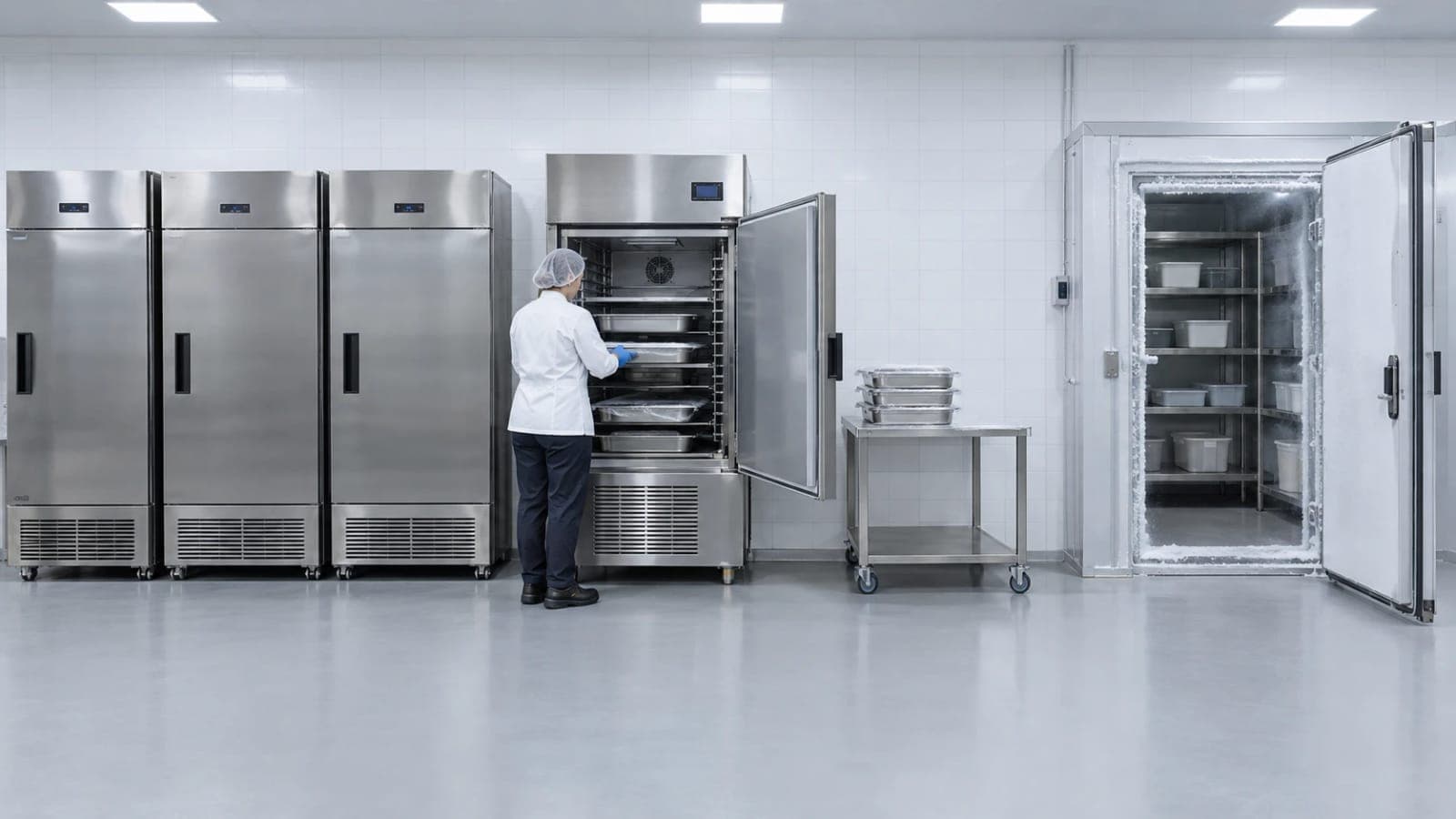
Here you'll find equipment from factories that build for professional catering and food retail, not reinforced domestic units. Every machine states its capacity, its temperature range and which factory it comes from, with the final delivered price.

What equipment this sector uses

Cold rooms

Refrigeration by volume, built to the space. It's the one category where the installation matters as much as the unit: the panels, the door and where the condensing unit sits shape performance as much as the power rating. They split into chilled (positive) and frozen (negative), and it rarely pays to size one to do both.

Blast chillers

They take freshly cooked product down through the temperature band where bacterial load grows fastest, rather than leaving it to cool on its own. They aren't fast freezers: the cycle is designed to cross that band without damaging texture. If you cook ahead or work sous-vide, this is the machine that makes it viable.

Refrigerated cabinets

The workhorse of the kitchen: service refrigeration, solid door, opened constantly. What decides it here is how many times it's opened per hour and how fast it recovers temperature, not the litres on the brochure.

Display units

Refrigeration that also sells. Preservation is only half the job: if the lighting or the shelf layout stops the customer reading the label, the unit does its technical job and fails its commercial one.

How to choose

  1. 1

    Usable capacity, not gross

    Catalogue volume includes space you'll never load: evaporator, dividers, air circulation. Think in how many trays or crates of your format actually fit, not in litres.

  2. 2

    Your room temperature, not the lab's

    Units are rated for a specific ambient temperature. A cabinet that performs at that rating won't perform the same in a closed kitchen in summer. If your premises run hot, that figure matters more than the price gap between two models.

  3. 3

    Static or fan-assisted

    Fan-assisted spreads temperature more evenly and recovers faster after each opening; static dries unwrapped product less. Neither is better: one suits what you store.

  4. 4

    Installation before price

    Available supply, whether it needs a dedicated circuit, minimum clearance for the condenser to breathe, and condensate drainage. A well-chosen unit badly installed uses more power and fails sooner.

Frequently asked questions

Can I use a chiller to freeze?

Not reliably. A chilled unit can be pushed to low temperatures, but it isn't sized to hold them or to handle the thermal load of freezing. It ends up running permanently at its limit, which is the fastest way to kill a compressor.

What maintenance does refrigeration need?

Mainly condenser cleaning and seal checks. It's the cheapest maintenance there is and the most ignored: a dirty condenser raises consumption and shortens compressor life.

Does it arrive ready to plug in?

Self-contained units do. Cold rooms and remote-condenser units need assembly and refrigeration commissioning by a technician.

And if it breaks?

You open the case with us, not with the factory. LeanSupport explains the whole process.

Can't find the machine you're after?

Tell us what you need to solve and we'll find the factory.

Send an enquiry